6 Tips to Start Painting Today!

Have you always admired beautiful oil paintings, and always wanted to pick up the brush, but do not know where to start? Painting might seem like a daunting task but it’s actually not as hard as it looks. Here we explore 6 ways to take the first step to your artistic journey, as well as to gain inspiration from artists who have mastered the art of painting.
 1. Start small
As the saying goes,
“a journey of a thousand miles begins with a single step”. Often, you may feel daunted by the scale and time that most paintings seem to require. When you start with small paintings, you see the results of your work quickly. As they require less time to complete, you will have more time to focus on truly mastering the skills and techniques of painting. Completing multiple small paintings that take a few hours each is the first step in integrating painting into your daily lifestyle.


2. Don’t be afraid of the blank canvas – or of failure
“Many painters are afraid of the blank canvas, but the blank canvas is afraid of the painter who dares and who has broken the spell of ‘you can’t’ once and for all.”
– Vincent Van Gogh
The famous painter once wrote these words in an emotional letter to his brother. Van Gogh was a Dutch post-impressionist painter whose work was influential on 20
th-century art. In his lifetime, he had produced over 2100 artworks. He believed that “
if one wants to be active, one mustn’t be afraid to do something wrong sometimes, not afraid to lapse into some mistakes… That leads to stagnation, to mediocrity. Just slap something on it when you see a blank canvas staring at you with a sort of imbecility.” Learning to daringly apply paint on a canvas is an important part of painting, and knowing that constantly re-working multiple layers of paint is what gives the finished work depth and substances.

Another important point to remember is that no one is a master on the first day –
“all things are difficult before they are easy” – Thomas Fuller. Don’t let the concept of failure stop you from enjoying yourself in the moments of creating — an activity that should not only be relaxing but meaningful in itself, as a journey of personal discovery and creation.
3. Paint from things that surround you
“Painting is just another way of keeping a diary.” ― Pablo Picasso
“Art is not what you see, but what you make others see.” – Edgar Degas
French artist Edgar Degas was a classical painter of modern life. Additionally, he was a master at depicting movement which favoured the subject of dancers. While he initially worked with realism, he is often identified as an Impressionist. The Impressionists painted the realities of the world around them through capturing the immediate effects of light and colour in order to express what they saw in an exact moment. By capturing scenes of everyday contemporary Parisian life, and his portraits of individuals and groups such as that of his aunt’s family, his paintings are striking reflections of his time.
The best way to develop a lifestyle of painting is by drawing inspiration from your everyday life – seeing the spectacular in the ordinary and translating it into your own artistic vision.

4. Sketch, sketch, sketch
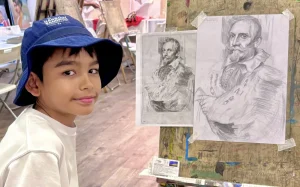
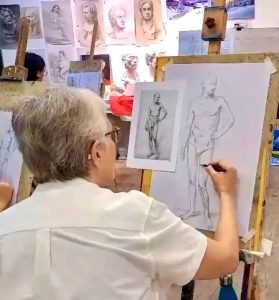
A key step to starting a painting, and subsequently mastering proportion and perspective is to sketch: as an important foundation, sketching regularly will help your ability to observe and translate what you see onto the canvas. Drawing and sketching also cultivates patience, mental alertness and perseverance.
If you’re new to drawing and sketching, why not join us at VAC for our
Drawing & Sketching course! Specially targeted at beginners and all levels of experience, you will learn basic concepts of proportion and composition, and learn to represent and give weight to objects using shading (light, contrast, representation/form).

5. Don’t let the materials be more important than the painting
Perhaps one of the obstacles that you may face when thinking of picking up the brush, is actually knowing where to buy a good brush, or to buy the paints. It’s important to not be overwhelmed by the range of brands and materials out there that seem crucial to oil painting, but actually are just products of marketing and advertising. The most basic materials such as oil paints (basic hues of Cadmium Yellow, Cadmium Red and Cerulean Blue, as well as Titanium White can be mixed to almost every shade of colour), 2-3 good brushes and a jar of turpentine is all you need to start painting. When you are overwhelmed by the materials, always remember that “
tools do not make a craftsman”; rather, the actual painting skills are more important.
And if you’re still stuck with getting the right materials, why not join us at
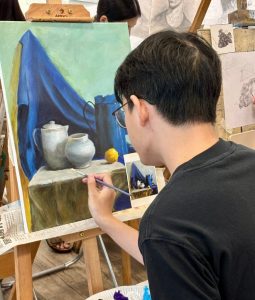
Painting for Beginners at VAC? All materials are provided, including canvases, brushes, paints, turpentine, palettes, easels, aprons, and of course, a beautiful studio space. No more worrying, start painting!

6. Don’t make excuses. Make time.
No one is ever “too busy”. It’s whether you can make time in your schedule to dedicate to painting, even if it’s once a week. It can be incredibly daunting to think of painting often, but if you can find a small opportunity and space, and get into the habit of painting, the idea is far less scary.
And a great opportunity to do this is through the
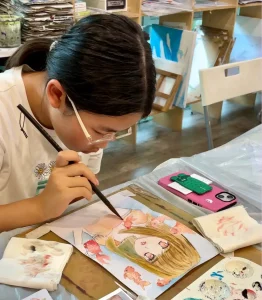
Oil/Acrylic Painting course at Visual Arts Centre. Over the course of 8 sessions, you will be taught the complexities of painting under the professional guidance of our instructors, in a comfortable and fully equipped studio space. The regularity of the sessions and flexibility of time slots means that you have no excuses in fitting it into your schedule, so come down and paint with us today!
 Disclaimer: All of the images in this post belong to their respective owners.
Credit:
http://www.huffingtonpost.com/2014/12/08/daily-painting_n_6271296.html
http://www.dailypainters.com/
http://www.dummies.com/how-to/content/oil-painting-for-dummies-cheat-sheet.html
https://commons.wikimedia.org/wiki/Category:Google_Art_Project
http://clubnarwhalblog.com/2013/04/quotes-about-hard-work.html/