Figure drawing, otherwise known as nude life drawing, is defined as the drawing of the human form in various shapes and postures, in different drawing media. Knowledge of figure drawing is foundational in classical art and vital for capturing the nuances of human anatomy, movement, and personality.


Frauengruppe (1904) by Lovis Corinth
Figure drawing can be represented expressively, loosely, or in a highly detailed manner or photorealistic. Artists are able to take a wide variety of approaches to human figure drawing, from creating works from photographic references, to creating works from life models, and even from imagination.


Claudia by Robert Zeller
Nude Figure References

When creating works from life models, one would be able to create artistic renderings that are less “flat”, more accurate and more true to reality. The visual reference of having a life model can allow one to produce works that are more anatomically accurate, with proportions more easily rendered as opposed to photographic references. Artists can also record the dynamics and movement of the human body more holistically as compared to drawing with a still image reference.
Types of Media

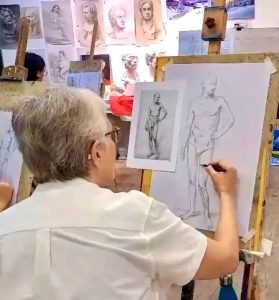
The preferred form of media when it comes to nude life drawing for most artists are dry mediums such as pencil, graphite or charcoal. Pencils and charcoals are most preferred as they adhere more loosely to the paper, allowing one to manipulate by erasing mistakes with ease. Furthermore, they can be easily preserved on paper, simply by spraying fixative on top of the drawing.
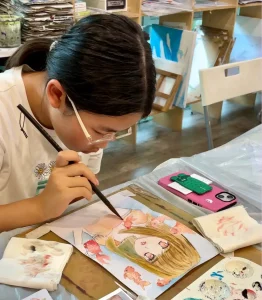
Watercolour nude life paintings have also gained much traction in recent years, with more people being interested in capturing the beauty of the nude with subtle colours. Usually, artists like to begin with a sketch using graphite pencil, and with the line work, watercolour ink washes are applied to the sketch.
Appreciating Nude Life Drawing and Painting


Male Nude (between 1854-1857), Auguste Rodin
When referencing to a nude life model, every pose offers a unique composition – shadows, skin textures, movement, perspectives and gestures. With the live model, we are expected to draw and paint at a faster rate compared to referencing to a still photograph. This allows us to train our eyes to understand the nuances of natural weight and balance and capture proportion quickly.
Nude Life Drawing and Painting Classes

Figure drawing and painting in a studio setting typically involves a group of students sitting around a model in a semi or full circle. Every student will be offered a different angle, with no 2 students having the same angle and perspective as another. Thus, each student’s drawing will reflect the artist’s unique perspective and location relative to the model.
In some classes, the nude model would also be interacting with props such as tables and chairs. In most nude life classes, a couple of periodic poses are expected, since it requires lots of energy for the model to pose and remain perfectly still for extended periods of time.
Learning never exhausts the mind.
– Leonardo Da Vinci